OSHA does not hand manufacturers a single risk matrix or formula to follow. OSHA requires employers to address applicable workplace hazards under its standards and the General Duty Clause, while OSHA’s Recommended Practices encourage a structured process for identifying hazards, evaluating severity and likelihood, and prioritizing controls. This guide shows manufacturers how to build an OSHA-aligned risk assessment process around those principles.
What “OSHA Risk Assessment” Really Means for Manufacturers
Under the Occupational Safety and Health Act’s General Duty Clause, employers have a duty to provide a workplace free from recognized hazards that are causing or are likely to cause death or serious physical harm. Standards across 29 CFR 1910 (General Industry) reinforce this by requiring hazard identification and control for specific exposures, from machine guarding to chemical handling. OSHA does not prescribe one universal risk scoring method. Instead, its Recommended Practices for Safety and Health Programs call for identifying hazards, evaluating severity and likelihood, and prioritizing corrective actions using a reasonable, documented process appropriate to the facility.
For manufacturers, an OSHA-aligned risk assessment in practice means systematically walking production areas, identifying what can hurt people, estimating how bad the outcome could be and how often workers face that exposure, then selecting and documenting control measures. Risk assessments typically follow five key steps: identifying hazards, evaluating severity and likelihood, implementing controls, documenting findings, and reviewing the assessment on a recurring basis. Core steps in conducting an OSHA-style risk assessment include identifying hazards and implementing controls.
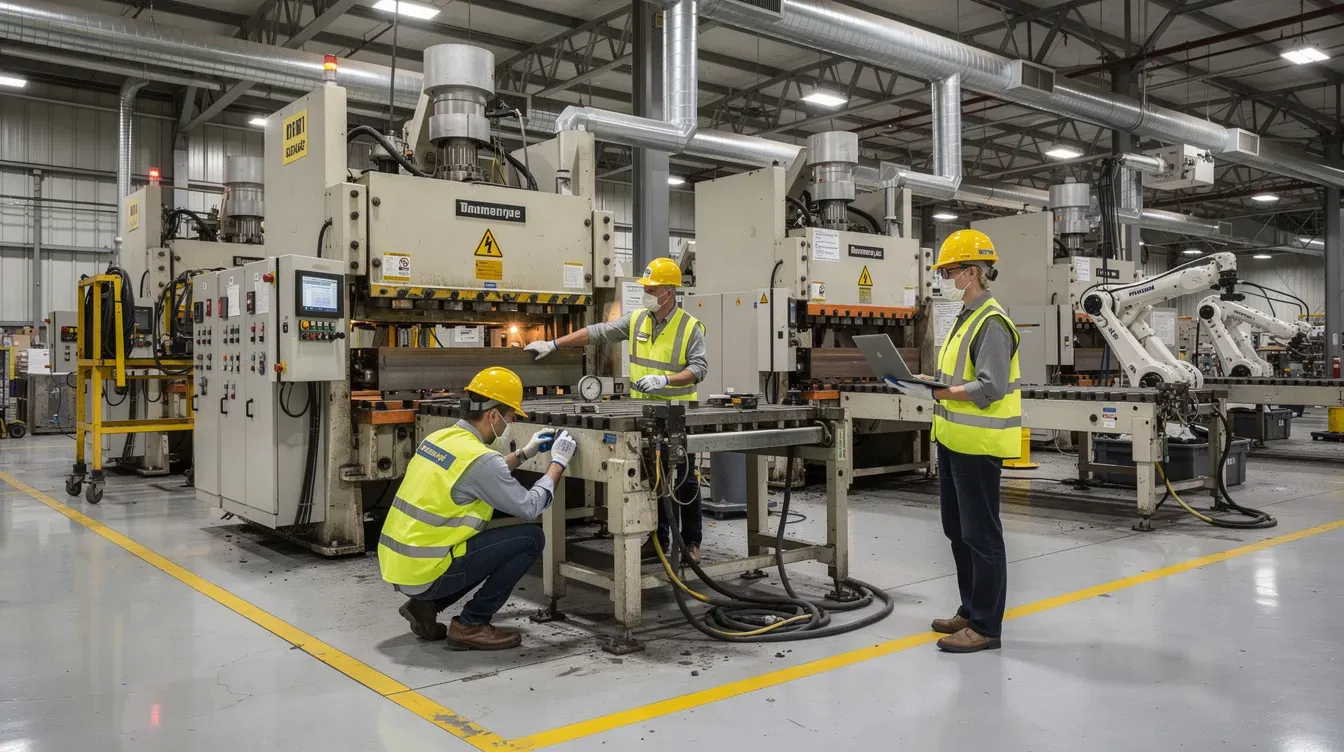
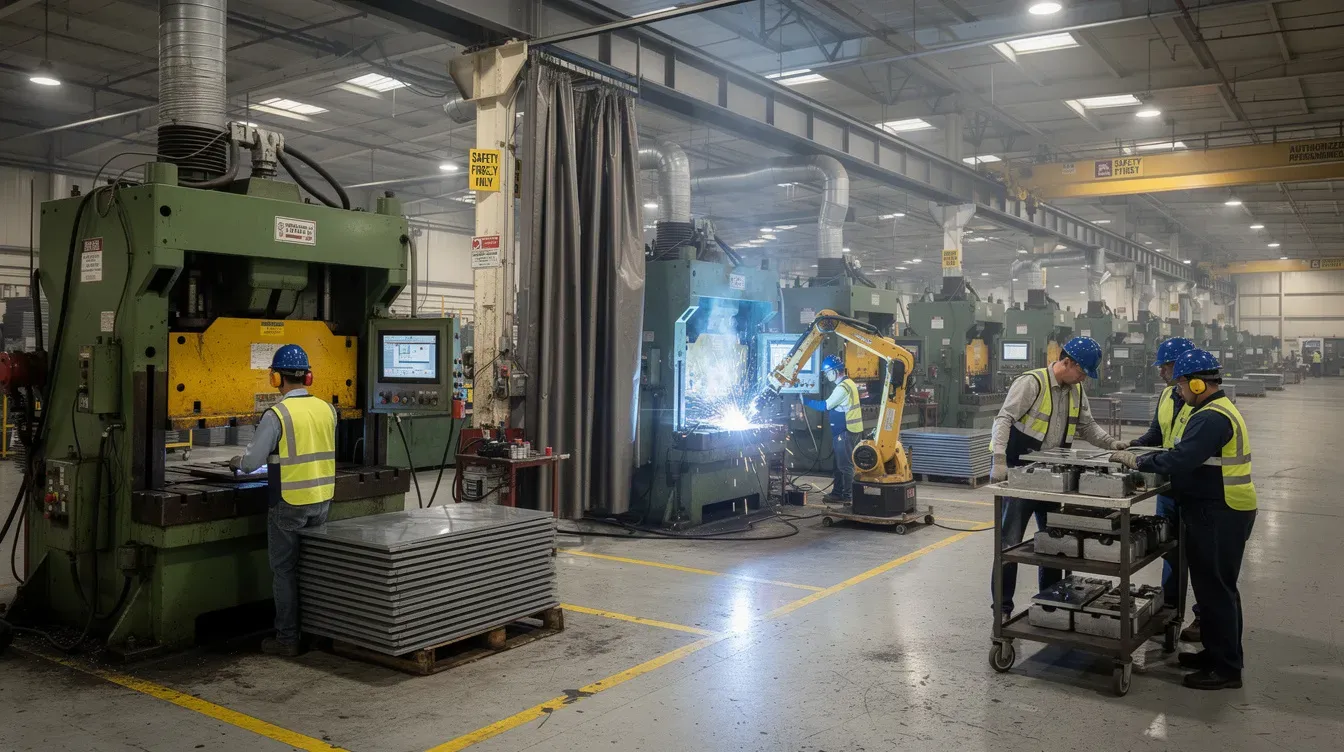
On a shop floor, this looks like evaluating arc flash and fume inhalation risks at a robotic welding cell, assessing crush points on a metal stamping press, reviewing forklift traffic patterns in a warehouse, or quantifying hexavalent chromium exposure in a plating operation. The goal of an OSHA risk assessment is to find hazards before they cause harm. A documented risk assessment can help show how hazards were identified, prioritized, and tracked during an OSHA inspection or incident investigation, although documentation by itself does not establish compliance. Effective risk assessments may also help reduce the operational and financial impact associated with workplace injuries, incidents, and uncontrolled hazards, and they help organizations move from reactive to proactive safety management.
Bolster Safety Craft’s Benchmark Assessments and Ongoing Assessments are structured to help manufacturers build and maintain this kind of documented, risk-based process.

OSHA Hazard Assessment vs. Broader Workplace Risk Assessment
OSHA’s standards often require task- or job-specific hazard assessments. The PPE hazard assessment under 29 CFR 1910.132(d), for example, focuses on whether specific tasks demand personal protective equipment. Other OSHA standards — including lockout/tagout, permit-required confined spaces, and machine guarding requirements — impose hazard-specific evaluation, procedure, or control obligations. The exact requirement varies by standard. A broader workplace risk assessment covers the entire facility, including interactions between processes, maintenance activities, and changeover procedures.
Hazard identification is the process of finding things that can cause harm, such as an unguarded rotating shaft or a corrosive chemical. Risk assessment evaluates how likely that harm is under real conditions and how severe the consequences could be for each of the hazards identified.
Key differences between the two approaches:
- OSHA hazard assessment: Standard-specific OSHA assessment or evaluation: requirements vary by standard. PPE explicitly requires a workplace hazard assessment and written certification, while other standards may require evaluations, procedures, exposure monitoring, or specific controls.
- Workplace risk assessment: spans all departments, processes, and support areas; uses a risk matrix or structured method to prioritize hazards based on severity, likelihood, and number of workers exposed; supports capital planning and safety improvements beyond minimum compliance.
Occupational safety and health requirements set the floor. A structured risk assessment process provides the framework above that minimum, allowing management to rank risks by severity and likelihood.
Step 1: How Manufacturers Identify Workplace Hazards
An effective risk assessment starts with thorough hazard identification. Step 1 involves identifying workplace hazards systematically across production lines, maintenance areas, warehousing, and support spaces such as boiler rooms and electrical panels. OSHA’s Recommended Practices advise employers and workers to collect and review existing information about workplace hazards before and during field evaluation.
Practical methods to identify hazards include:
- Scheduled facility inspections and machine audits (regular workplace inspections help identify safety hazards over time)
- Walkthroughs involving EHS staff and frontline workers
- Review of OSHA 300/301 logs, near-miss reports, incident reports, and workers compensation records
- Examination of maintenance and reliability records for recurring hazards such as guard removals or equipment failures
- Review of safety data sheets for chemical hazards
- Review of inspection reports from previous audits
Employees should be involved in the hazard identification process as they often know about unsafe conditions that observers miss. Health hazards include chemical, physical, biological, and ergonomic risks. Typical manufacturing hazard categories include mechanical hazards (unguarded pinch points, nip points on conveyors), electrical hazards (exposed live parts), chemical hazards (solvent degreasers, isocyanate coatings), ergonomic risks leading to musculoskeletal injuries (manual pallet handling), physical hazards (elevated occupational noise, heat stress), and biological hazards where applicable.
For non-routine tasks such as changeovers, maintenance shutdowns, confined space entries, and line startups, hazard identification is especially critical because procedures, exposures, and controls differ from normal operations. For a practical workplace risk assessment, document each identified hazard with its location, associated task or exposure group, and current controls so the finding can be evaluated and tracked.
Bolster Safety Craft’s workplace safety consulting and Industrial Hygiene services can strengthen this identification step in complex plants where internal resources lack specialized expertise.
Hazard Identification Methods and Tools for OSHA Risk Assessments
Several structured tools help manufacturers identify potential hazards and turn observations into actionable findings.
Job hazard analysis (JHA/JSA) breaks a task into discrete steps. For a press brake setup, those steps might include positioning the die, adjusting the ram stroke, testing the cycle, and running production. At each step, the assessor records hazards (crush point between ram and die, pinch from clamping, noise exposure) and proposes controls.
Process hazard analysis (PHA) applies to complex or high-hazard operations such as chemical blending, combustible dust handling, or pressurized systems. Under OSHA’s Process Safety Management standard, a process hazard analysis is required for processes covered by 29 CFR 1910.119, including certain highly hazardous chemicals at or above specified threshold quantities and qualifying flammable-gas or flammable-liquid processes.
Checklists and standard inspection forms aligned with OSHA standards (machine guarding under 1910.212, powered industrial trucks under Subpart N, walking-working surfaces under Subpart D) ensure no obvious hazards go unrecorded. Teams should conduct regular inspections using these forms.
Incident investigations and near-miss analyses uncover underlying hazards that routine inspections miss. Incident investigations reveal hazards likely to cause future harm, such as repeated near-collisions on forklift routes or flashback burns at welding stations. Previous injuries documented in OSHA logs point to recurring hazards.
Employee involvement through toolbox talks and cross-functional walkthrough teams improves the breadth of hazard identification, especially for dynamic tasks like maintenance or warehouse operations where work processes change frequently.
When internal resources lack specialized industrial hygiene, machine safety, or PSM experience, bringing in an external EHS consultant for a structured exercise, such as Bolster Safety Craft’s Benchmark Assessments, adds an outside perspective and comparison to industry work practices.

Evaluating Severity and Likelihood in OSHA Risk Assessments
Once hazards are identified, the next risk assessment step is estimating potential outcomes. Step 2 evaluates the severity and likelihood of risks for each hazard.
A company-defined severity scale for a manufacturing risk assessment might include:
- First-aid only (minor cut, bruise)
- OSHA recordable (laceration requiring stitches, chemical irritation)
- Lost-time injury (broken bone, significant burn)
- Permanent disability (amputation, hearing loss)
- Fatality
- Catastrophic facility event (explosion, chemical release)
Likelihood depends on frequency of exposure, number of employees exposed, task duration, and history of similar incidents. A risk matrix (commonly 3×3 or 5×5) plots severity against likelihood to produce a risk rating for each hazard. OSHA does not mandate a specific matrix format; it is a practical tool, not a regulatory requirement.
Consider a concrete example: an unguarded press flywheel adjacent to a worker station. Severity is amputation (high). Likelihood is high because the affected employee interacts with the area daily. Risk rating: critical. Compare that to a small debris pile on a walkway: severity is minor (trip, bruise), likelihood is moderate. Risk rating: low risk. A structured method in risk assessments allows management to rank risks like these and allocate resources to addressing hazards with the greatest potential harm first.
For some hazards — particularly airborne contaminants and noise — quantitative exposure data may be necessary or highly useful to characterize employee exposure accurately rather than relying on observation alone.
Prioritizing Corrective Actions and Applying the Hierarchy of Controls
The purpose of a risk assessment is to prioritize control measures for the highest risks, not to fill out forms. Step 3 implements controls to eliminate or minimize hazards, starting with the hazards rated most severe and most likely.
Use risk rankings to build a prioritized action list with deadlines, responsible persons, and milestones. Risk rankings can help sequence corrective actions, but recognized serious hazards should be controlled promptly regardless of their position in a scoring matrix, with interim controls used where necessary.
The hierarchy of controls prioritizes risk reduction measures in this order:
- Elimination of hazards is the most effective control method. Example: removing a manual lifting task entirely by redesigning the workflow.
- Substitution is the second level. Example: replacing solvent-based coatings with water-based alternatives to reduce risk from volatile organic compounds.
- Engineering controls follow substitution. Examples: installing machine guards and interlocks on presses, adding local exhaust ventilation at spray booths, enclosing robotic cells with safety-rated fencing and presence-sensing devices.
- Administrative controls are implemented after engineering controls. Examples: job rotation schedules to reduce repetitive strain, written emergency procedures, employee training tied to identified hazards, shift scheduling to limit heat exposure duration.
- Personal protective equipment (PPE) sits at the lowest level of the hierarchy of controls and is often used alongside higher-level controls when those controls do not fully eliminate exposure. Examples: cut-resistant gloves at stamping stations, hearing protection where required under the applicable occupational-noise and hearing-conservation requirements, respirators for hexavalent chromium exposure when other controls are insufficient.
Hazards must be identified before selecting appropriate personal protective equipment. Combining multiple levels is standard practice: a spray booth might use engineering controls (exhaust ventilation), administrative controls (written procedures and training), and PPE (respirators) together to protect workers.
Preventing incidents through effective risk management may reduce costs associated with medical treatment, downtime, and lost productivity. Bolster Safety Craft’s Written Programs and Fractional Safety Director services help convert risk assessment findings into site-specific control programs that stay current with operational risks.

Documentation, Corrective-Action Tracking, and OSHA Expectations
In this five-step risk assessment framework, Step 4 is documentation and corrective-action tracking. OSHA does not impose one universal recordkeeping requirement for a generic workplace risk assessment. Specific standards may require written hazard assessments, certifications, exposure-monitoring records, training records, or other documentation. Even where a particular format is not mandated, documenting risk assessment findings makes it easier to assign corrective actions, verify completion, and evaluate whether controls remain effective.
Key elements to document for each hazard based assessment:
- Hazard description and location
- Affected job titles or groups
- Initial risk rating (severity + likelihood)
- Current controls in place
- Recommended additional controls
- Responsible owner for corrective action
- Target completion date
- Residual risk rating after controls
OSHA requires written certification of hazard assessments under specific standards. For PPE, 29 CFR 1910.132(d)(2) requires a written document that includes the workplace evaluated, the person certifying, the date, and a statement that the document is a certification. Recordkeeping requirements should be checked against each applicable OSHA standard rather than assumed to be identical for every hazard assessment.
Corrective actions can be tracked using EHS software or, for smaller manufacturers, well-structured spreadsheets and signed paper forms. Documentation should be reviewed regularly to ensure accuracy. Periodic management review of open and overdue corrective actions ties directly to overall safety performance metrics.
Bolster Safety Craft’s Ongoing Assessments and workplace safety consulting help maintain disciplined tracking and closure of corrective actions over time.
When Industrial Hygiene Testing Is Required in OSHA Risk Assessments
Some hazards cannot be assessed by observation alone. When workplace information indicates that airborne contaminants, noise, or other physical agents may approach applicable exposure limits or action levels, quantitative exposure assessment or monitoring may be required or appropriate. The exact obligation depends on the applicable OSHA standard, and some standards permit objective data or other exposure-assessment methods.
Common manufacturing situations where exposure monitoring or industrial hygiene assessment may be required or appropriate include:
- Welding fumes containing manganese or hexavalent chromium
- Respirable crystalline silica from cutting, grinding, or sandblasting
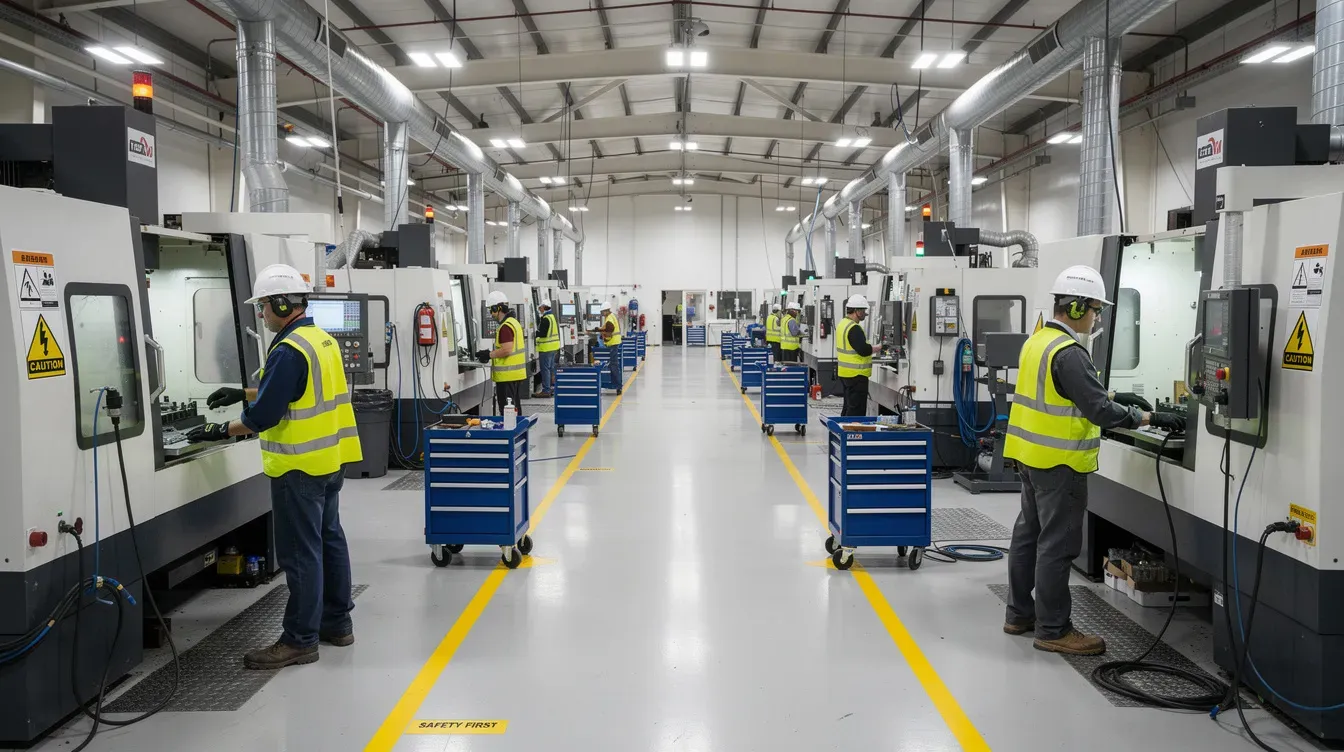
- Metalworking fluid mist in CNC machining areas
- Isocyanates in spray finishing operations
- Solvent vapors from degreasing or coating
- Employee noise exposures approaching or exceeding OSHA’s 85 dBA 8-hour TWA action level under 29 CFR 1910.95
- Heat stress in foundry or furnace operations
OSHA substance-specific standards such as 1910.1026 for hexavalent chromium and 1910.1053 for respirable crystalline silica contain specific exposure-assessment requirements. Under the general-industry silica standard, employers must assess employees who are or may reasonably be expected to be exposed at or above the action level. The standard allows either a performance option using appropriate monitoring or objective data, or a scheduled-monitoring option. Under scheduled monitoring, representative personal breathing-zone samples must reflect exposures by shift, job classification, and work area.
Industrial hygiene data refines the risk rating: Quantitative exposure results can materially change the characterization and priority of a hazard. An exposure above an applicable permissible exposure limit can trigger specific control, monitoring, notification, or other requirements depending on the standard, and control measures must escalate accordingly. Findings feed back into the risk assessment, influencing decisions on local exhaust ventilation, process enclosure, substitution, and respirator selection.
Bolster Safety Craft’s Industrial Hygiene services support this process through sampling design, onsite collection, laboratory analysis, and reporting for workplace exposure risks.
How Often to Repeat an OSHA Risk Assessment in Manufacturing Facilities
Risk assessment is not a one-time project. Step 5 involves reviewing and updating the assessment regularly. Risk assessments should be reviewed periodically and when relevant equipment, processes, materials, incidents, or workplace conditions change.
Triggers for repeating or updating assessments include:
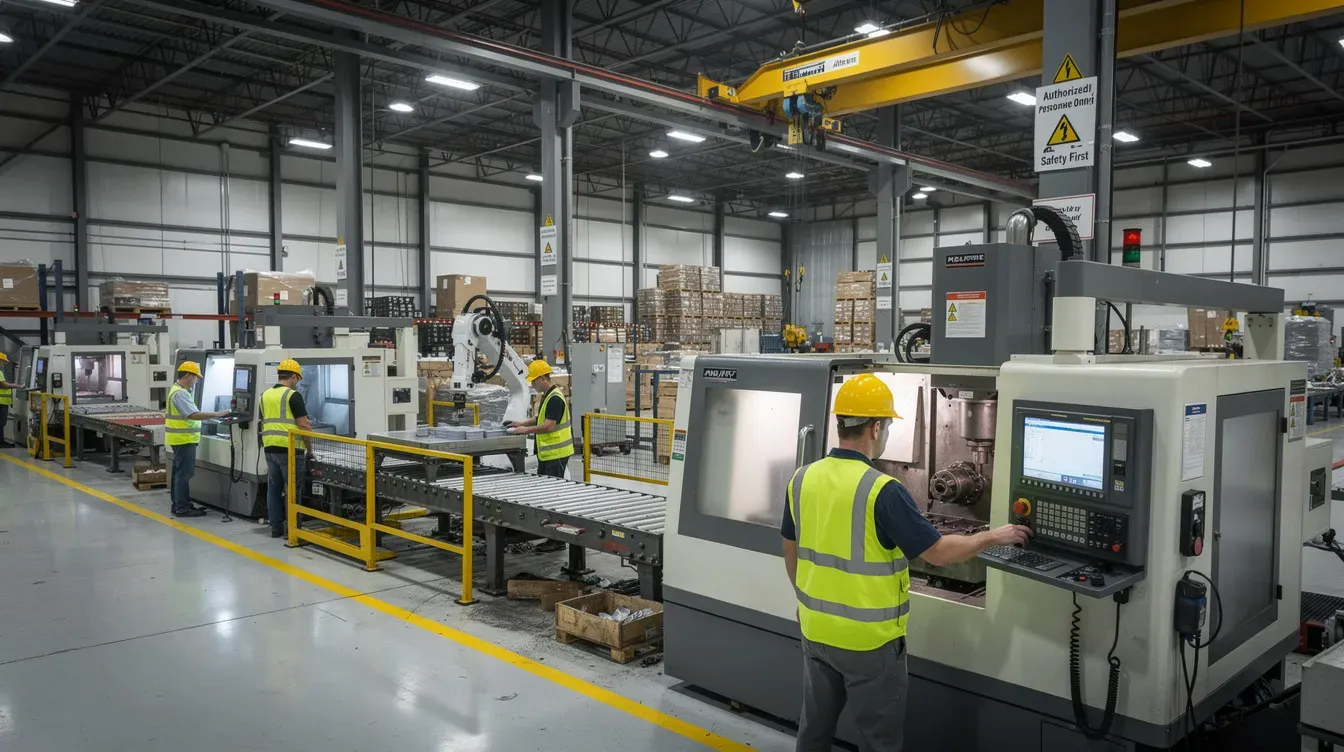
- Installation of new equipment or production lines (e.g., a new CNC machining cell)
- Major process or material changes, including introduction of new chemicals
- Facility expansions or layout modifications
- Regulatory changes (new or revised OSHA regulations)
- Serious incidents, near misses, or new hazards identified through incident investigations
- Results from internal or external audits
There is no single OSHA-mandated interval for repeating a comprehensive facility-wide risk assessment. Manufacturers should use event-based triggers — such as equipment, process, material, staffing, incident, or regulatory changes — together with a defined internal review cadence appropriate to the operation’s risk profile. Specific OSHA standards may impose their own periodic monitoring, evaluation, or reassessment requirements. OSHA’s Recommended Practices also advise employers to periodically verify that controls remain effective, including when conditions, processes, or equipment change.
Integrating review dates into your EHS calendar and management-of-change process keeps reassessment from becoming an afterthought. Bolster Safety Craft’s Ongoing Assessments are part of a broader suite of safety services designed to keep risk assessments current as production schedules, workplace conditions, and workforce composition shift.
Risk Assessment vs. OSHA Compliance Audits and Common Mistakes
Many manufacturers confuse a compliance audit with a risk assessment. They serve different purposes and cover different ground.
An OSHA compliance audit checks whether specific regulatory requirements are met: Are machine guards in place? Is the lockout/tagout program documented? Are training records current? It answers yes-or-no questions about regulatory status.
A risk assessment goes further, asking how likely and how severe harm could be from both regulated and unregulated hazards, then prioritizing resources accordingly. Risk assessment helps prevent injuries and occupational illnesses by identifying gaps a compliance audit alone would miss.
Common mistakes in OSHA risk assessments:
- Treating the assessment as a paperwork exercise with no on-site field verification
- Failing to involve frontline employees who understand actual work practices
- Underestimating low-frequency but high-severity events like catastrophic amputation or chemical release
- Ignoring contractor work, temporary workers, and maintenance activities
- Not updating assessments after incidents or process changes, leaving new hazards unaddressed
- Over-relying on personal protective equipment without exploring higher-level controls like engineering controls or substitution
Integrating compliance audits and risk assessments strengthens both. Audit findings refine hazard identification, and risk rankings help prioritize hazards that compliance checklists alone cannot rank. Bolster Safety Craft’s Benchmark Assessments combine regulatory gap analysis with risk-based prioritization to avoid these pitfalls.
How an External Safety Consultant Conducts a Structured OSHA Risk Assessment
Bringing in external expertise makes sense during rapid growth, when opening new facilities, after a spike in recordable incidents, or when internal EHS staff are stretched thin across complex processes.
A typical consulting engagement follows this workflow:
- Pre-visit: gather OSHA logs, incident investigation reports, existing written programs, training records, chemical inventories, and facility layout drawings.
- On-site walkthroughs: observe production, maintenance, and support areas; document workplace conditions and identify potential hazards.
- Task-level observations and worker interviews: capture how tasks are actually performed versus how procedures describe them.
- Risk matrix development: build or refine a risk matrix calibrated to the client’s specific hazard profile (mechanical, chemical, noise, ergonomic).
- Joint workshops: review hazards identified with operations, maintenance, and safety professionals; agree on risk ratings.
- Prioritized corrective action plan: document the findings, recommended priorities, responsible owners, and target completion dates.
A fractional safety director model provides ongoing guidance to implement controls, monitor progress, update risk assessments, and conduct employee training tied directly to the findings, and there are several signs you may need this role. An experienced consultant also supports incident investigations, coordinates industrial hygiene testing, and helps develop emergency procedures.
Bolster Safety Craft supports these needs for small and middle-market manufacturers that need senior safety leadership through fractional safety director support as well as established EHS teams across diverse industrial sectors that need additional bandwidth or specialized expertise.

Frequently Asked Questions About OSHA Risk Assessment in Manufacturing
What is the difference between a hazard and a risk?
A hazard is anything with the potential to cause harm. An unguarded rotating shaft is a hazard. Risk combines the likelihood that someone will contact that shaft and the severity of the resulting injury. Guard the shaft with an interlock, and the risk drops because likelihood decreases, even though the hazard (the shaft) still exists. Risk assessment identifies and evaluates workplace hazards systematically using this distinction.
Does OSHA require a specific five-step risk assessment or risk matrix?
No. OSHA does not mandate one universal five-step risk assessment method or risk matrix for all workplaces. Specific OSHA standards may require particular hazard assessments, evaluations, exposure monitoring, procedures, or documentation. Separately, OSHA’s Recommended Practices encourage employers to identify hazards, evaluate severity and likelihood, prioritize corrective actions, implement controls, and verify their effectiveness.
Who is responsible for conducting and maintaining OSHA risk assessments?
The employer is responsible for meeting applicable OSHA obligations. Depending on the organization, plant managers, operations leaders, EHS professionals, supervisors, and qualified specialists may conduct or maintain different parts of the risk assessment process, while worker participation provides important knowledge about actual workplace conditions. Plant managers, operations leaders, and safety professionals typically lead the technical work. Supervisors ensure job-level assessments are accurate, and employees contribute detailed knowledge of actual workplace conditions. Risk management responsibilities extend to covering contractor and temporary worker safety as well.
How does risk assessment help with OSHA compliance and incident prevention?
A structured risk assessment can support compliance by identifying workplace hazards, connecting them to applicable requirements, prioritizing corrective actions, and identifying where training, written programs, exposure monitoring, or additional controls may be needed. Some OSHA standards require specific written certifications or records, but a generic risk assessment does not by itself establish compliance or guarantee that citations will be avoided. Worker safety improves because control measures are selected based on evidence rather than assumptions, and safety and health goals are tied to measurable risk reduction.
When should a manufacturer repeat or update a risk assessment?
Key triggers include new equipment or processes, introduction of new chemicals, incidents or near misses, regulatory changes, and results from audits. Manufacturers should build re-assessment into management-of-change and continuous-improvement processes. No universal OSHA schedule applies to every manufacturing facility. Establish a review cadence based on the operation’s risk profile and update assessments when equipment, processes, materials, workplace conditions, incidents, or applicable requirements change.
When is industrial hygiene testing necessary in a risk assessment?
Industrial hygiene monitoring may be required or appropriate when workplace information indicates that employees could be exposed to air contaminants, noise, or other physical agents near applicable action levels or exposure limits. The exact assessment method depends on the OSHA standard and the hazard. Some standards allow objective data or other exposure-assessment methods in addition to direct sampling. Common manufacturing concerns include welding fumes, respirable crystalline silica, solvent vapors, isocyanates, and occupational noise.
How can a manufacturer get started if they have never done a formal OSHA risk assessment?
Start with one pilot area or high-risk process. Conduct a basic hazard identification walkthrough, apply a simple qualitative risk ranking, and document what you find. Build out written procedures, control measures, and employee training from that initial effort. Expand to other areas as your team gains confidence. Bolster Safety Craft’s Benchmark Assessments provide a structured diagnostic starting point by identifying hazards and evaluating existing controls against compliance and industry benchmarks. Additional safety management resources and practical safety case studies show how findings can then inform corrective actions, written programs, training, industrial hygiene work, or ongoing safety leadership as appropriate, giving your team a practical foundation to reduce risk across the facility.