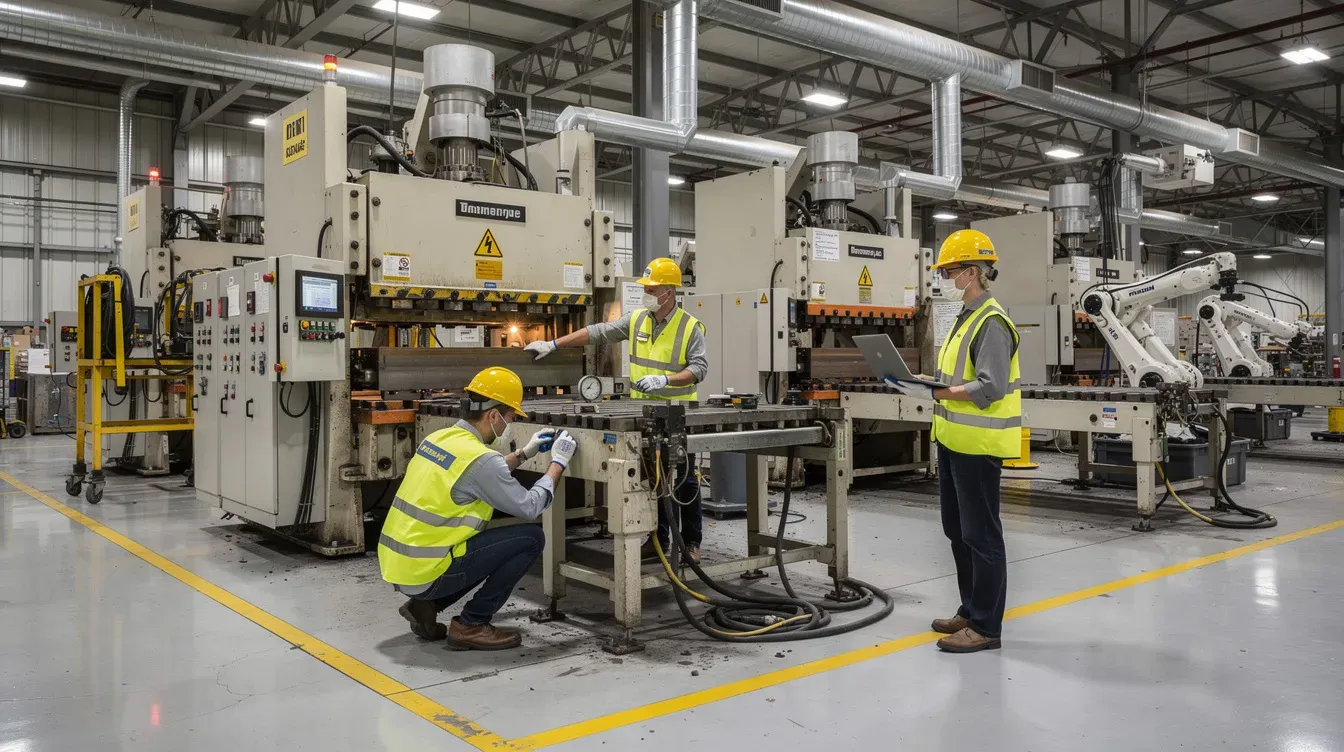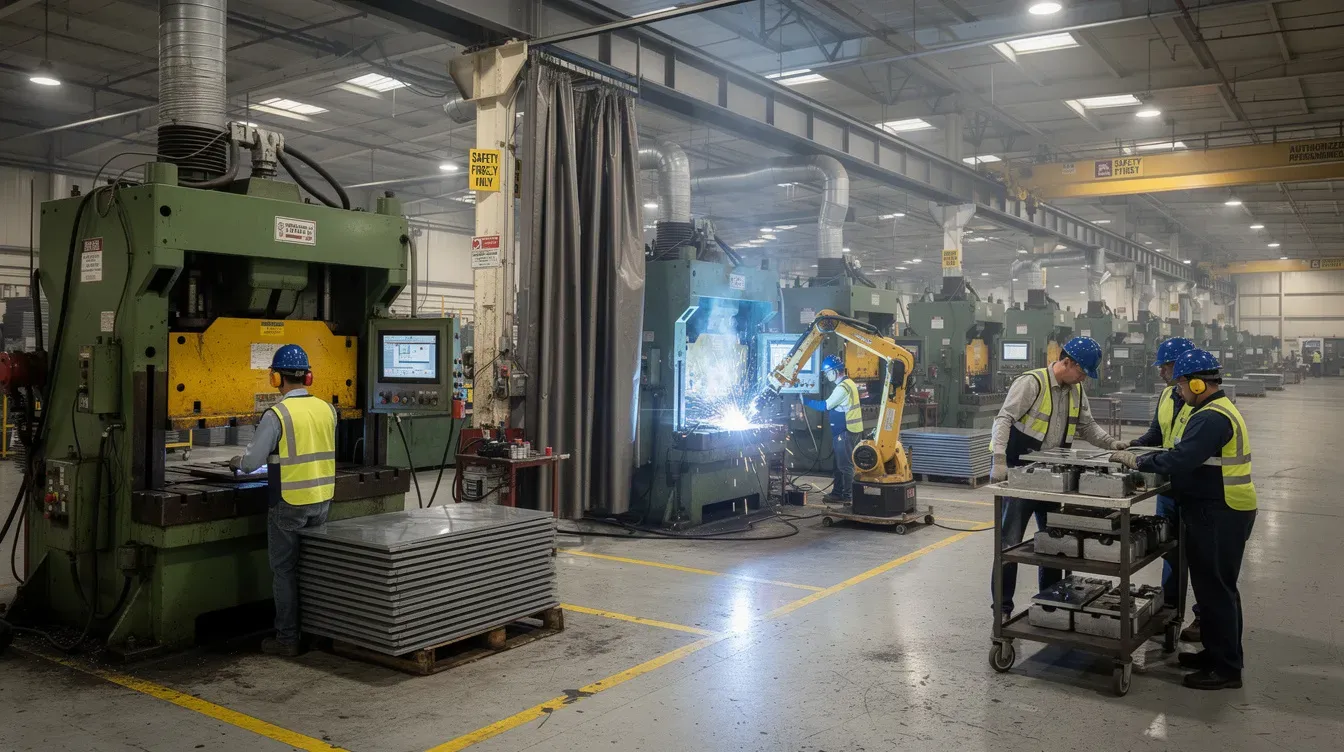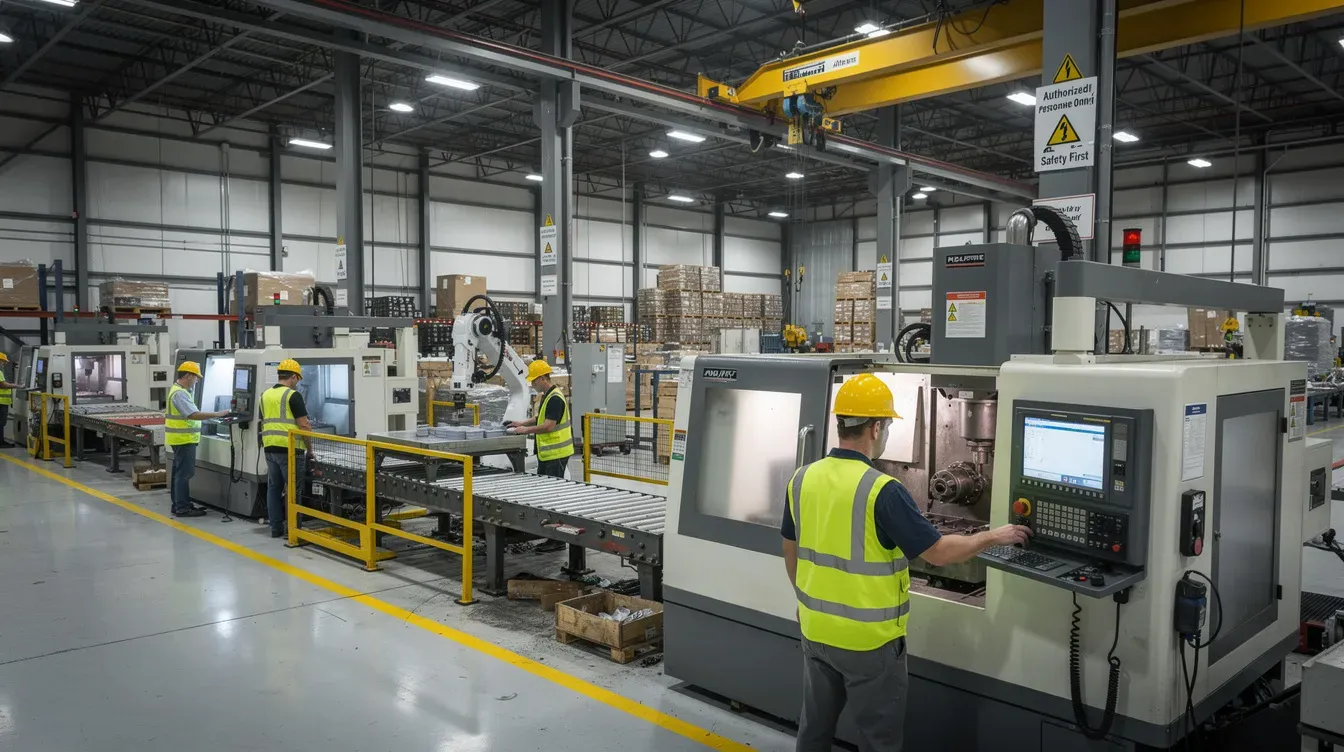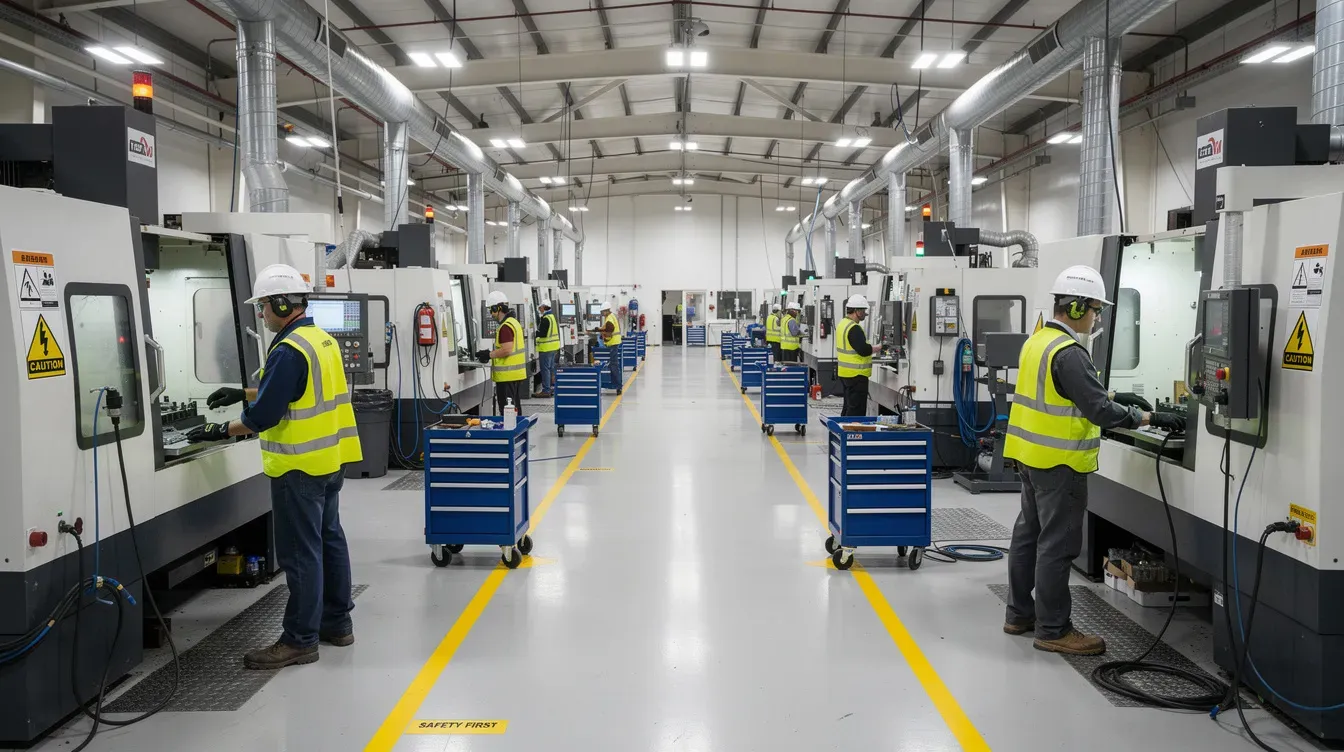
A safety and health management system is the structured framework a manufacturer uses to connect leadership responsibility, hazard identification, risk assessment, controls, training, inspections, corrective actions, and continuous improvement into one coordinated process. It is not a binder sitting on a shelf. It is the operating system for workplace safety, built into how production, maintenance, and supervision run in everyday operations.
This guide is written for manufacturing leaders, plant and operations managers, HR leaders, and EHS professionals who need to understand how a structured workplace safety management system works and how to build or strengthen one.
Manufacturing environments carry a wide range of hazards — machine guarding gaps, hazardous energy during maintenance, powered industrial truck traffic, welding fume, chemical exposures, noise, and contractor work, to name a few. Managing them one program at a time tends to leave gaps between programs. A management system is how those programs get connected, prioritized, and kept current.
One point up front: the Occupational Safety and Health Administration (OSHA) does not require every employer to adopt one formally named “Safety and Health Management System.” Manufacturers work across three layers — specific OSHA regulatory requirements, OSHA’s voluntary Recommended Practices, and the management practices each company chooses for itself. This guide keeps those layers separate.
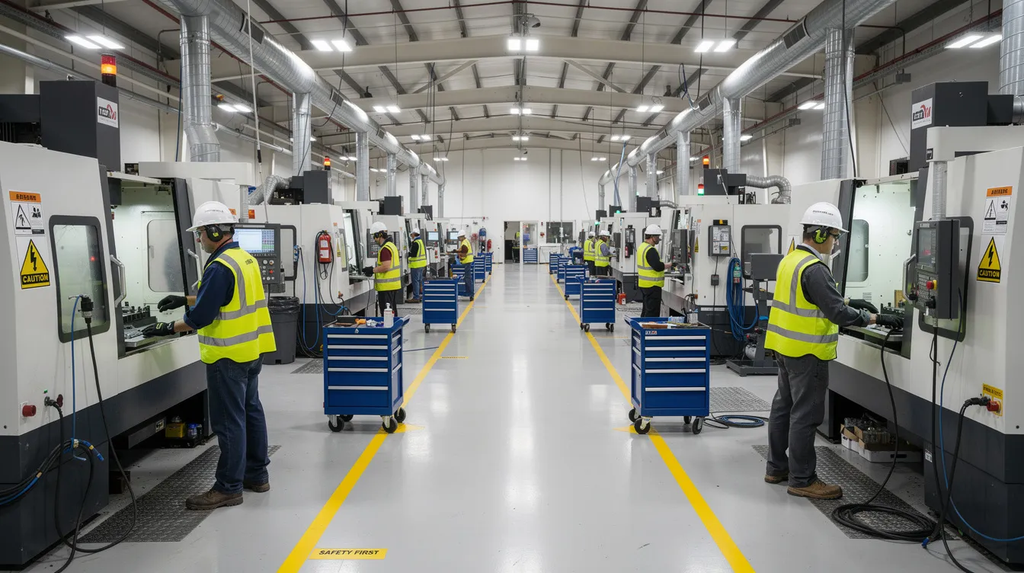
What Is a Safety and Health Management System?
A safety and health management system is an organization-wide way to plan, organize, implement, measure, and improve occupational safety and health. Its policies, procedures, and practices are designed to work together rather than in isolation.
An individual safety program — a standalone lockout/tagout program, for example — addresses one hazard category. A management system ties that program to defined roles, risk-based priorities, a training schedule, corrective-action tracking, and a regular review cycle, so it does not operate in a vacuum.
The building blocks typically include leadership commitment, worker participation, hazard identification and risk assessment, controls selected using the hierarchy of controls, training and communication, documentation, inspections, and verification that controls are working. The system is meant to find and fix hazards before they cause harm, and it is a continuous process rather than a one-time project.
Companies may build on frameworks such as OSHA’s Recommended Practices for Safety and Health Programs or ISO 45001, the international standard for occupational health and safety management systems. Adopting a particular framework is a business decision, not a universal regulatory requirement.
Why Manufacturers Need a Structured Safety Management System
Consider a hypothetical plant running several production lines with welding, machining, and assembly. Policies live in scattered folders. Toolbox talks happen when someone remembers. Inspections happen mostly after incidents. Corrective actions sit in a spreadsheet no one reviews. When a contractor arrives to modify a conveyor, no one is sure who briefs them on the facility’s hazards. Each piece exists; none of them are connected.
Disconnected efforts make it hard to prioritize risks, assign accountability, and verify that fixes actually happen. Manufacturing adds its own pressure points — frequent changeovers, maintenance and repair work, capital projects, new equipment, and temporary labor — and each one exposes gaps when there is no unified system holding the pieces together.
A structured safety and health management approach gives an operation clearer accountability, better visibility into its highest risks, a defined way to connect hazards to the OSHA safety standards and regulations that apply, and more consistent training and supervision. That makes regulatory compliance something the operation manages deliberately rather than discovers during an inspection. It also gives leadership a way to see whether the safety function is moving forward or simply reacting — which matters when safety work competes for time with production targets and operational efficiency.
OSHA’s Recommended Practices for Safety and Health Programs
OSHA’s Recommended Practices for Safety and Health Programs (OSHA 3885, published in October 2016) update the agency’s 1989 program management guidelines. OSHA states plainly that the document is advisory: employers are not required to have a program that follows it and will not be cited for failing to. Construction has its own separate version.
That makes it important to keep three layers distinct:
- OSHA regulatory requirements — enforceable standards that apply based on the hazards and operations present, such as lockout/tagout (29 CFR 1910.147) or hazard communication (29 CFR 1910.1200), along with the General Duty Clause.
- OSHA’s Recommended Practices — a voluntary framework for managing safety and health systematically.
- Company-selected practices — the structure, tools, risk-ranking methods, and review cadence an organization chooses for itself.
The Recommended Practices are built around seven interrelated core elements:
- Management leadership — top management commits to safety and health, sets goals, assigns responsibilities, and provides resources. In a plant, that might mean leadership requiring a risk review before a production change that affects machine guarding.
- Worker participation — workers are involved in setting goals, identifying and reporting hazards, investigating incidents, and evaluating controls, and can raise concerns without fear of retaliation. Operators helping evaluate guarding options on their own machining line is a practical example.
- Hazard identification and assessment — hazards from routine, nonroutine, and emergency work are identified, evaluated, and prioritized, for example through job hazard analyses for press brake setup and operation.
- Hazard prevention and control — controls are selected using the hierarchy of controls, with a plan for implementation, interim protection, tracking, and verification.
- Education and training — workers, supervisors, and managers understand the program, the hazards they face, and the controls in place.
- Program evaluation and improvement — performance is monitored, controls are checked for effectiveness, and shortcomings are corrected.
- Communication and coordination for host employers, contractors, and staffing agencies — everyone on site, including contract and temporary workers, gets the same hazard information and protection. In manufacturing, that often means coordinating with maintenance contractors, equipment vendors, and staffing agencies before work starts.
Many manufacturers use the Recommended Practices as a blueprint for their occupational safety and health management approach, then scale each element to their size and risk profile.
Hazard Identification and Risk Assessment
Hazard identification is the foundation of the system, and it starts on the floor: walkthroughs of production lines, maintenance shops, loading docks, and warehouses to find energy sources, line-of-fire exposures, pinch points, and chemical or physical agents. It also draws on existing information — OSHA 300 and 301 logs, near-miss reports, safety data sheets, equipment manuals, maintenance records, and input from the people who do the work.
Risk assessment then evaluates the severity and likelihood of harm for each hazard, so limited time and capital go where they matter most. Typical examples include caught-in hazards at a press brake, fall exposures at mezzanine edges, ammonia in refrigeration systems at food plants, or silica during cutting and grinding. Common tools include job hazard analysis, task-based risk assessment, and machine risk scoring.
OSHA does not require one specific risk matrix or scoring method. Manufacturers choose a consistent approach suited to their operations. Ranking also has limits: recognized serious hazards still need prompt control, with interim measures where necessary, regardless of where they fall on a matrix. For a step-by-step look at this process, see our guide to OSHA risk assessment for manufacturers.
Bolster Safety Craft’s Benchmark Assessments apply this process at the corporate level. They establish a ranked hazard inventory baseline across one or multiple sites, measure control effectiveness against compliance and industry benchmarks, and produce a prioritized, budgetable path forward.
Written Safety Programs and Procedures
Written programs are essential parts of a safety management system, but a well-written program does not by itself produce safe work. Which written programs, procedures, and certifications are required depends on the OSHA standards you must comply with, based on your hazards. Examples include a written hazard communication program (1910.1200), energy control procedures (1910.147), a written permit-required confined space program (1910.146), a written respiratory protection program where respirators are required (1910.134), and a certified PPE hazard assessment (1910.132(d)). Other standards set program requirements without prescribing a specific written document.
Programs built from a plant’s actual hazard exposure inventory work better than generic templates. Machine-specific lockout procedures that match the real equipment, hot work permits written for the facility, and powered industrial truck rules adapted to the actual floor layout and dock operations are easier for supervisors to enforce as written. Clear procedures also define what acceptable practice looks like on high-exposure tasks such as changeovers, die setting, and chemical transfers.
Bolster Safety Craft develops custom written safety programs starting from a hazard exposure inventory rather than a template. These range from a comprehensive 1910 general industry safety manual to single-program policies written to your controls.
Employee Training and Safety Communication
Written programs only work when they become practical, hazard-specific training that frontline employees can apply under production pressure. Which training is required depends on actual exposures and duties. Common manufacturing examples include:
- Powered industrial truck operator training, evaluation, and employer certification.
- Lockout/tagout training for authorized and affected employees.
- Hazard communication.
- PPE.
- Hearing conservation where noise exposures meet the action level.
- Respiratory protection where respirators are required.
Refresher requirements also vary by standard. Some are annual, while others are triggered by changes in equipment, processes, or observed performance. Beyond standard-specific topics, supervisors and managers benefit from training on core safety concepts and on their own role in the program — how to respond to hazard reports, run an incident investigation, and enforce procedures consistently. The goal is to equip employees at every level with the necessary safety knowledge for the work they actually do.
Most plants combine formal training — new-hire orientation, standard-specific sessions, and refreshers where required — with on-the-floor methods such as pre-shift huddles, coaching, and visual work instructions at the machine. OSHA 10- and 30-hour Outreach courses can supplement a program, but they are generally voluntary under federal OSHA and do not replace the training that specific standards require. Training records — who was trained, on what, when, and how comprehension was verified — support internal accountability and show what was provided if questions arise later.
Open communication should run both ways. Leadership sets expectations, explains the controls in place, and spells out the specific actions required. Employees give feedback on near misses, equipment problems, and procedures that do not match how the work is actually done.
Bolster Safety Craft offers customized safety training built from your hazard exposure inventory and controls, delivered in classroom and hands-on formats and documented. For a standard-by-standard overview, see OSHA training requirements for general industry.
Industrial Hygiene and Exposure Assessment
Some hazards cannot be judged by observation alone. Industrial hygiene measures employee exposure to airborne contaminants and noise so decisions rest on data rather than assumptions. Common manufacturing scenarios include solvent vapors at parts washers and coating operations, welding fume in fabrication areas, respirable crystalline silica during cutting and grinding, metalworking fluid mist at CNC machines, and high noise near stamping presses and compressors.
Quantitative exposure assessment typically means:
- Designing a sampling strategy around tasks, shifts, and exposure groups.
- Collecting personal and area samples with calibrated equipment.
- Having samples analyzed by an accredited laboratory.
- Comparing results to applicable OSHA permissible exposure limits and action levels.
The exact obligation depends on the standard. Some substance-specific standards require exposure assessment, and some allow objective data or other methods in place of sampling.
The results feed back into the safety and health management system. They can drive engineering changes such as local exhaust ventilation, written program updates, PPE and respirator selection, hearing conservation decisions, and targeted training.
Bolster Safety Craft’s Industrial Hygiene service covers sampling design, onsite collection, laboratory analysis, and reporting for workplace exposure risks. It includes noise dosimetry, noise mapping, NIOSH-method personal and area air monitoring, and qualitative respirator fit testing.
Corrective Actions, Inspections, and Ongoing Assessments
Identifying hazards is only half the work. A disciplined corrective-action process is what turns findings into actual risk reduction. Every finding — from an inspection, risk assessment, incident investigation, or employee report — needs:
- A clear owner.
- A target date.
- A defined control.
- A verification step confirming the fix works.
Manufacturing examples include replacing missing conveyor guards, re-engineering a manual lift, adjusting a ventilation hood over a welding station, or redesigning forklift and pedestrian traffic after a near miss.
Inspections keep the process supplied with current information. Supervisor walkthroughs, pre-use equipment checks, and periodic machine safeguarding reviews catch conditions that drift over time as equipment wears, layouts change, and production pressure builds. Some standards set their own inspection intervals; the lockout/tagout standard, for example, requires periodic inspection of energy control procedures at least annually.
Findings that stay open are where systems most often break down. Tracking each corrective action to verified closure — and reviewing open and overdue items with leadership — is what keeps the system honest.
Bolster Safety Craft’s Ongoing Assessments provide this cadence. The service combines scheduled facility audits with documented findings and assigned owners, corrective-action tracking through to closure, leading-indicator dashboards, and OSHA recordkeeping review.
Leading Indicators and Continuous Improvement
Lagging indicators — injury and illness counts, rates, and workers’ compensation data — show what has already happened. Leading indicators track the activities and conditions meant to prevent incidents and accidents before they happen. Practical examples include:
- Corrective actions closed by their target date.
- Inspection findings and how quickly they are addressed.
- Recurring hazards.
- Near-miss and hazard reporting.
- Training completion for roles where training is required.
- Verification of critical controls such as interlocks, emergency stops, and guarding.
There is no OSHA-mandated list of indicators. Each company selects measures that reflect its risks and the maturity of its system.
Continuous improvement means using those measures to adjust the system. A common way to structure that is Plan–Do–Check–Act:
- Plan: set goals.
- Do: implement controls and training.
- Check: review indicators, inspections, and incidents.
- Act: adjust programs, equipment, or training.
Many organizations review key measures in regular safety or operations meetings so trends are visible to the people who can act on them.
Who Should Own the Safety Management System?
Responsibility for meeting OSHA obligations rests with the employer. Specific tasks can be assigned to individuals or outside specialists, but the employer’s responsibility does not transfer with them.
In practice, ownership is shared:
- Executives set objectives and provide resources.
- Operations leaders and plant managers build safety into production planning.
- EHS professionals provide technical direction.
- Supervisors enforce procedures and coach daily.
- Employees participate by reporting hazards, helping evaluate controls, and following established procedures.
A strong safety culture shows up in these behaviors — supervisors who enforce procedures the same way every shift, employees who report hazards because they see them fixed, leaders who close the loop — more than in posters or slogans. Those roles should be documented within the system — through policy statements, defined responsibilities, or responsibility matrices for key processes. Examples are who approves lockout procedures, who issues confined space entry permits, and who coordinates with contractors.
In smaller and mid-sized operations, safety often starts as a side duty for an HR manager, an operations lead, or maintenance. Outside specialists can help carry the load, but they support the employer’s responsibility rather than replace it.
When a Fractional Safety Director Makes Sense
A fractional safety director provides senior safety leadership on a recurring, part-time basis rather than as a full-time hire. The model tends to fit a few situations:
- A growing operation that has outgrown safety as a side duty, where the floor has become more complex, a second shift or second site has been added, and responsibility is split across people who each carry only part of it.
- An established EHS team that needs senior bandwidth for a season — a multi-site audit cycle, a program rebuild, or coverage during a staffing gap — without adding permanent headcount.
- A company preparing for a sale or ownership transition that wants its safety function documented and transferable rather than held in one person’s memory.
In these situations, a fractional safety director can design and run core parts of the safety and health management system. That includes owning written programs and the corrective-action list, setting the audit and training calendar, prioritizing risk-based projects, and reporting trends to leadership. The company’s own leaders still own their decisions; the fractional director builds and maintains the system those leaders run.
Bolster Safety Craft’s Fractional Safety Director service is led personally by Tim Walsh, CSP, ASP, on a monthly retainer sized to the operation. Engagements start with a diagnostic assessment, then settle into a recurring cadence of programs, audits, training, incident and inspection support, and leadership reporting.
Safety Management Systems for Wisconsin Manufacturers
Wisconsin does not operate an OSHA-approved State Plan, so most private-sector employers in the state fall under federal OSHA jurisdiction. For Wisconsin manufacturers, that means federal OSHA standards — and the federal Recommended Practices — are the reference points for structuring a safety and health management system.
Manufacturing is a significant part of Wisconsin’s economy, spanning metal fabrication, food processing, paper and packaging, and machinery production. Operations that combine machining, welding, material handling, chemical use, and maintenance work carry a broad mix of exposures. That breadth is exactly where a structured approach to hazard identification, risk prioritization, and corrective-action follow-through pays off.
Tim Walsh earned his B.S. in Occupational and Environmental Safety and Health at the University of Wisconsin–Whitewater. Learn more about our workplace safety consulting in Wisconsin.
How an External Safety Consultant Can Help Strengthen a Safety Management System
Manufacturers bring in outside safety consultants for an objective view of current conditions, specialized expertise, or additional bandwidth. A consultant can:
- Evaluate the current state of the system.
- Identify and rank hazards.
- Review programs and training against the standards that apply.
- Help develop written programs and training.
- Support industrial hygiene work.
- Establish an inspection and corrective-action cadence that keeps the system accountable.
Bolster Safety Craft’s approach follows a consistent sequence:
- Diagnose: an objective Benchmark Assessment of hazards and current controls, benchmarked against compliance and industry standards.
- Prescribe: services matched to the operation’s risk profile, such as written programs, safety training, and industrial hygiene sampling.
- Sustain: follow-through through Ongoing Assessments or a Fractional Safety Director retainer.
For organizations building a system from the ground up, or preparing for ISO or VPP audits, Bolster also offers Safety Management System development and audit preparation.
An outside consultant adds expertise and capacity, but it does not replace engaged leadership or participation from supervisors and employees. The strongest engagements pair external expertise with clear internal ownership.
Frequently Asked Questions About Safety and Health Management Systems
What is a safety and health management system?
A safety and health management system is an integrated framework of policies, defined responsibilities, hazard identification, risk controls, training, inspections, corrective actions, and review processes that work together to manage workplace safety and health. It connects individual safety programs into one coordinated system rather than treating each in isolation.
Does OSHA require a safety management system?
Not as a single, universal requirement. OSHA enforces specific standards — such as lockout/tagout, hazard communication, and machine guarding — that apply based on the hazards present, along with the General Duty Clause. OSHA’s Recommended Practices for Safety and Health Programs describe a management-system approach, but OSHA identifies them as voluntary guidance, not an enforceable standard.
What are the main elements of a safety and health management system?
OSHA’s Recommended Practices describe seven core elements: management leadership, worker participation, hazard identification and assessment, hazard prevention and control, education and training, program evaluation and improvement, and communication and coordination for host employers, contractors, and staffing agencies. Other frameworks, such as ISO 45001, organize similar elements differently.
What is the difference between a safety program and a Safety Management System?
A safety program usually addresses one subject, such as lockout/tagout or respiratory protection. A safety management system is the broader structure that connects all of those programs to roles, priorities, risk assessment, corrective actions, and continuous improvement, so they function as a coordinated whole.
Who is responsible for managing workplace safety?
The employer is responsible for meeting its OSHA obligations. Within the safety and health management system, executives, managers, supervisors, EHS professionals, and employees each have defined roles. Outside specialists can support that work but do not take on the employer’s responsibility.
How often should a Safety Management System be reviewed?
There is no single OSHA-mandated review frequency for a safety management system as a whole. The right cadence depends on the system, the operation’s risk profile, operational changes, incidents, and the company’s own procedures. OSHA’s voluntary Recommended Practices suggest evaluating a program at least annually. Specific standards set their own intervals for particular elements, such as the annual periodic inspection of energy control procedures under the lockout/tagout standard. Reviews are also warranted after new equipment or processes, significant changes, or serious incidents.
How do manufacturers measure whether their safety management system is working?
They track both lagging indicators (injury and illness trends, recordable cases, workers’ compensation data) and leading indicators (corrective-action closure, inspection findings, recurring hazards, near-miss reporting, training completion where required, and verification of critical controls). The specific measures are chosen by each company based on its risks.
Can an outside safety consultant manage a Safety Management System?
A consultant can help design, implement, and maintain the system. As a fractional safety director, a consultant can provide ongoing senior leadership for it. Legal responsibility for workplace safety and health remains with the employer, so the most effective engagements pair outside expertise with active internal ownership.